
Chris May: 93 kg after back surgery, now he tells men to stop dieting seven days a week
In an exclusive interview, the former U.S. Navy aviation rescue swimmer, who was in daily pain at 93 kg (205 lb), explains why fat loss does not need a deficit every day, and shares his chest workout and his favourite high-protein recipe.
Chris May's starting point was 93 kg (205 lb) and roughly 22% body fat, and those were the least of his problems. He had come through back surgery and was in pain every day. He had very little energy. After leaving military service, he was dealing with severe depression.
"The number on the scale was only a small part of it," he told us. "What really bothered me was how I felt every day."
Today, at 34, he lives on the Oregon Coast. He works full time training people in cardiac rehabilitation and cancer survivors, and runs his own coaching business, Sustained Health & Performance, around that job. His approach to fat loss starts with an idea most diets ignore: you do not have to be in a deficit seven days a week.
A career built on rescue
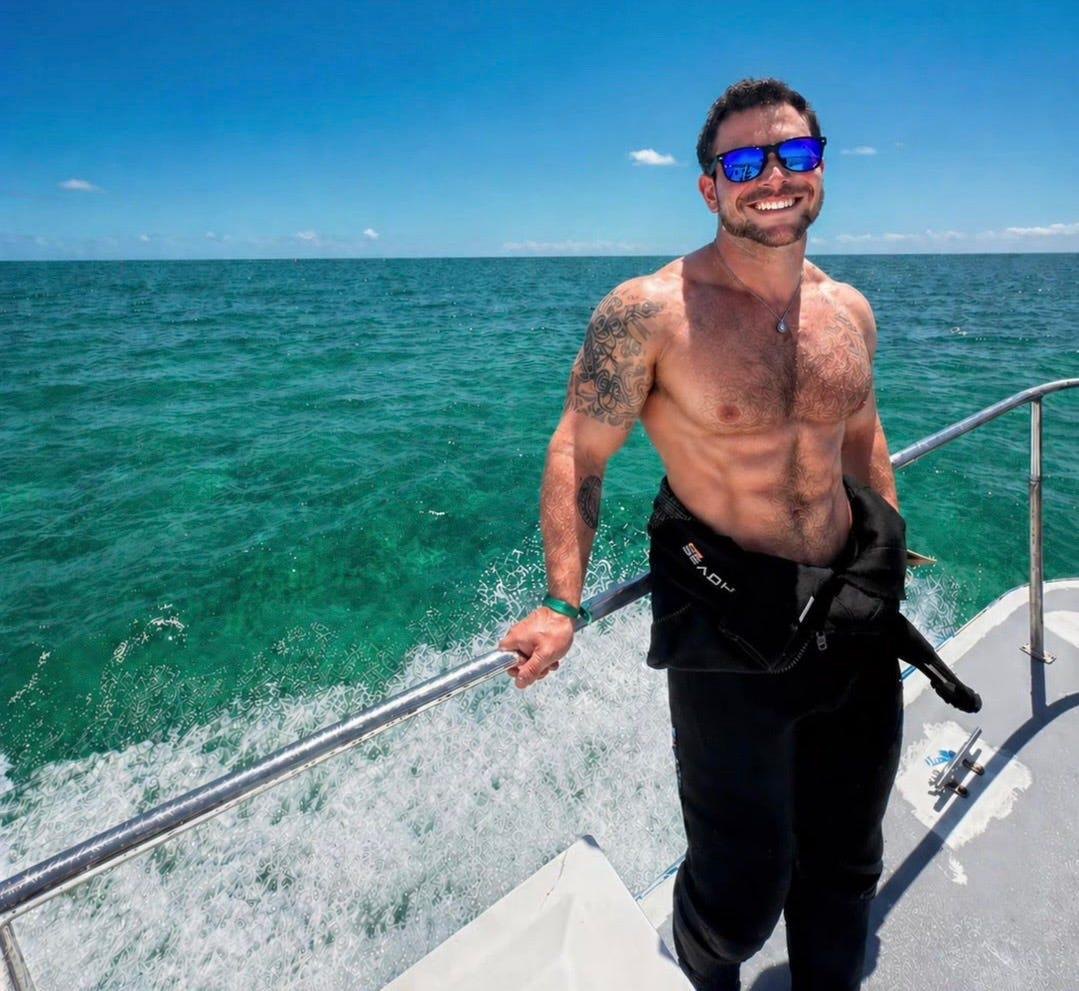
May grew up in Pennsylvania. He served in the U.S. Navy as an aviation rescue swimmer, the crew member who drops from a helicopter into open water to recover people in trouble. His background also includes firefighting and EMS. "Helping people has been a common thread throughout my life," he says.
The man he became after the service needed that help himself. Back surgery left him in daily pain. His energy was low. Depression set in, and he says he "didn't feel like myself."
The turning point was ordinary. He looked in the mirror one day and did not like who he saw, physically or in where his life was going. "I told myself, 'This is the day. I'm going to change and make myself better.'"
He is clear that nothing shifted overnight. The hardest part was rebuilding while still dealing with pain, low energy and his mental health at the same time. What kept him going was simpler than a goal weight. "I didn't want to return to how I had been feeling."
What the physique did not fix
The body changed first. The lesson that followed surprised him. "Changing my physique also made me realize I needed to work on the mental side of things," May says. "Looking different wasn't the whole answer."
Confidence came back. He found he could speak up for himself. He started working toward a master's degree in holistic nutrition and built Sustained HP to pass on what he had learned, professionally and personally.
His day job shapes how he coaches. In cardiac rehabilitation and cancer survivorship, the goal is rarely a leaner waist. It is strength, endurance, confidence and independence, so a patient can get back to the things they enjoy. "Sometimes it's about helping someone feel capable again," he says.
Ask him what people who only see his videos miss, and the answer has nothing to do with muscle. "I'm back to climbing around on hikes like a little kid again."

A day on the Oregon Coast
May trains before anything else can claim the day. Between his full-time job and his coaching clients, the working day runs about 11 hours.
| Time | What happens |
|---|---|
| 4:50 a.m. | Wakes up |
| About 6:00 a.m. | In the gym |
| 8:00 a.m. to 7:00 p.m. | Rehabilitation work, then coaching clients, programming, check-ins and content |
| Through the day | Five meals: lean meats, complex carbohydrates, fruit and vegetables |
| About 10:00 p.m. | In bed, just under seven hours before the alarm |
"Getting my training done early helps me stay consistent before the workday gets busy," he says. He is equally clear that this is his routine, not a template. "Your plan needs to work with your life."
Stop dieting seven days a week
May's best-known line targets the assumption that fat loss requires a deficit every single day. One structure he teaches is five days in a moderate calorie deficit and two days around maintenance, the energy your body uses to hold its current weight.
His worked example uses a man who maintains at about 2,500 calories a day:
| Day type | Days | Calories per day | Weekly total |
|---|---|---|---|
| Moderate deficit | 5 | 2,000 | 10,000 |
| Maintenance | 2 | 2,500 | 5,000 |
| Week | 7 | About 2,140 on average | 15,000 |
At maintenance every day, the same man would eat 17,500 calories a week. The 5-and-2 week still leaves a planned deficit of about 2,500 calories. May stresses that these figures illustrate the idea and are not a personal prescription.
The two maintenance days have rules. They are not cheat days. Meals stay balanced and protein stays consistent. "They're not a reason to eat everything in sight," he says.
He is also careful about what the method is not. It is not a metabolism reset, and it is not automatically better than a steady daily deficit. It is a way of organising the week that some people find easier to keep. "It's one strategy, not a rule everyone has to follow."
The workout: APEX Day 1, chest
This is the opening session of May's APEX Advanced programme. It is high-volume work for experienced lifters, not a beginner or rehabilitation session. Warm up with a few minutes of easy movement, then build through progressively heavier sets of the first press.
| Block | Exercise | Sets × reps |
|---|---|---|
| A, giant set | Bench press | 3 rounds × 5 |
| A, giant set | Incline dumbbell fly | 3 rounds × 15 |
| A, giant set | Dumbbell pullover | 3 rounds × 30 |
| B, superset | Incline dumbbell press, 5-second lowering | 3 rounds × 8–12 |
| B, superset | Wide-grip pull-up | 3 rounds × max controlled reps, 1 in reserve |
| C | Weighted dips | 5 × 10 |
| D, finisher | Standing cable fly | Bouts until 200 reps, 10 bouts or 10 minutes |
How to run it:
- Load: choose weight separately for each exercise and keep one or two good reps in reserve on every set.
- Bench safety: use safeties or a capable spotter.
- Pull-ups: use assisted pull-ups or a lat pulldown if needed.
- Dips: add weight only when bodyweight reps are fully controlled; assisted dips or a dip machine work too.
- Finisher: pick a load you can move for about 20 clean reps at first. Stop early if you cannot complete five clean reps or your technique starts to slip. "Those numbers are limits, not something to force through at the expense of form," May says.
How he uses failure
In his own bodybuilding training, May takes the last set of selected exercises to absolute failure. His definition is strict: the point where he cannot complete another clean rep through the intended range of motion. Grinding through pain or swinging the weight does not count.
He uses two intensity techniques, selectively and mostly on stable machine and cable exercises:
- Rest-pause: finish the final working set, rest 10 seconds, then add controlled reps until another clean rep is impossible.
- Cluster sets: mini-sets of three to five clean reps with three to five seconds of rest between them. Stop when three clean reps are no longer possible.
He never combines both on the same exercise, and he does not bolt them onto every final set. The APEX session already carries plenty of volume, so follow its reps-in-reserve targets instead of adding failure work throughout.
His rehabilitation clients get none of this by default. Cardiac and cancer-survivor patients need exercise built around their condition, recovery and medical guidance, "not a copy of my hardest workout."
The recipe: chicken-crust pizza
May's answer to eating the same meals every day is a pizza whose crust is made of chicken. It makes one medium pizza, roughly two servings.
Crust
- 340 g (12 oz) fully cooked, finely shredded chicken breast, or well-drained canned chicken, weighed after draining
- 1 large egg
- About 25 g (¼ cup) grated Parmesan
- ½ tsp garlic powder
- ½ tsp Italian seasoning
Toppings
- 60 ml (¼ cup) pizza sauce
- About 55 g (½ cup) shredded part-skim mozzarella
- Optional: turkey pepperoni, peppers, mushrooms or other toppings
Method
- Heat the oven to 220°C (425°F). Pat the chicken dry, spread it on a parchment-lined tray and bake 8–10 minutes to drive off moisture. Let it cool slightly.
- Mix the chicken, egg, Parmesan, garlic powder and Italian seasoning. Press firmly onto the lined tray into a crust about 6 mm (¼ inch) thick.
- Bake 18–22 minutes, until firm with golden edges and 74°C (165°F) in the centre on a food thermometer. Timing varies with thickness and oven.
- Add sauce, mozzarella and toppings. Bake 5–8 minutes more, until the cheese melts. Rest five minutes before slicing.
The key is moisture: dry the chicken properly and the crust holds together. May is clear this is an option, not a rule. "I also don't want people thinking every meal has to be a 'fitness version.'"
The mistake most men make
May's diagnosis is overreach. Men decide to train every day, cut every food they enjoy and change their body as fast as possible, treating fitness as punishment. "I'd rather help somebody build a realistic routine they can keep doing than a miserable routine they're counting the days until they can stop."
The second mistake is going it alone. Ask questions, learn how to train, get help when it is needed. The third is ego. "Training hard matters to me, but hard doesn't mean reckless. There's a difference between giving a set your full effort and letting your ego decide the weight."
Sustained HP
The name stands for Sustained Health & Performance, and May says the first word matters most. He does not want clients to progress for eight weeks and then feel lost when the programme ends. The aim is understanding training and nutrition well enough to carry the habits forward.
His website, sustainedhp.com, offers structured training programmes and workout trackers, personalised eight-week training plans, nutrition coaching, combined training and nutrition options, and 30- and 60-minute consultations. Higher-support coaching adds check-ins, feedback and adjustments. It serves beginners who need direction, men looking to lose fat or build muscle, and experienced lifters who want more structure.
A note to day one
Asked what he would tell himself at the start, May skips weights, lifts and appearance entirely.
"You will feel like yourself again. Silly and happy. One day, you'll be out on a hike, climbing around like a kid, and realize that part of you is still there. Keep going. Work on your mind as well as your body, and don't be afraid to get support along the way."
Chris May, 34, is a former U.S. Navy aviation rescue swimmer and the founder of Sustained HP. Follow him at @sustained_hp. The figures in this article are examples from his own practice, not individual medical or nutritional advice.
Photos: Chris May.