Light weights build as much muscle as heavy ones, if you take the sets close to failure
The belief that only heavy loads build size does not survive a review of the trials. Heavy loads still matter for one thing.
For decades the advice was simple: lift heavy for size, light for tone. The research does not support the second half.
In 2017, Brad Schoenfeld and colleagues published a meta-analysis in the Journal of Strength and Conditioning Research that pooled 21 studies comparing low-load training (60 percent of one-repetition maximum or less) with high-load training (more than 60 percent).
What they found
- Muscle growth was similar with low and high loads.
- Maximal strength improved more with high loads.
In other words, the weight on the bar matters less for size than the effort behind each set. A set of 25 that ends close to failure stimulates the muscle in a way a set of 25 that ends comfortably does not.
Why effort matters more than load
As a set approaches failure, the body recruits more and more of the muscle's fibres, including the large ones with the most potential for growth. Heavy loads recruit them from the first repetition. Lighter loads get there by the end of a hard set. Both routes reach the same place.
Strength is different. It is partly a skill: the nervous system learns to produce force against heavy loads. To get better at lifting heavy, you have to practise lifting heavy.
How to apply it
- For size, any rep range from roughly 6 to 30 works if the last few reps are hard.
- For strength, keep some heavy work, typically 1 to 6 reps, on the main lifts.
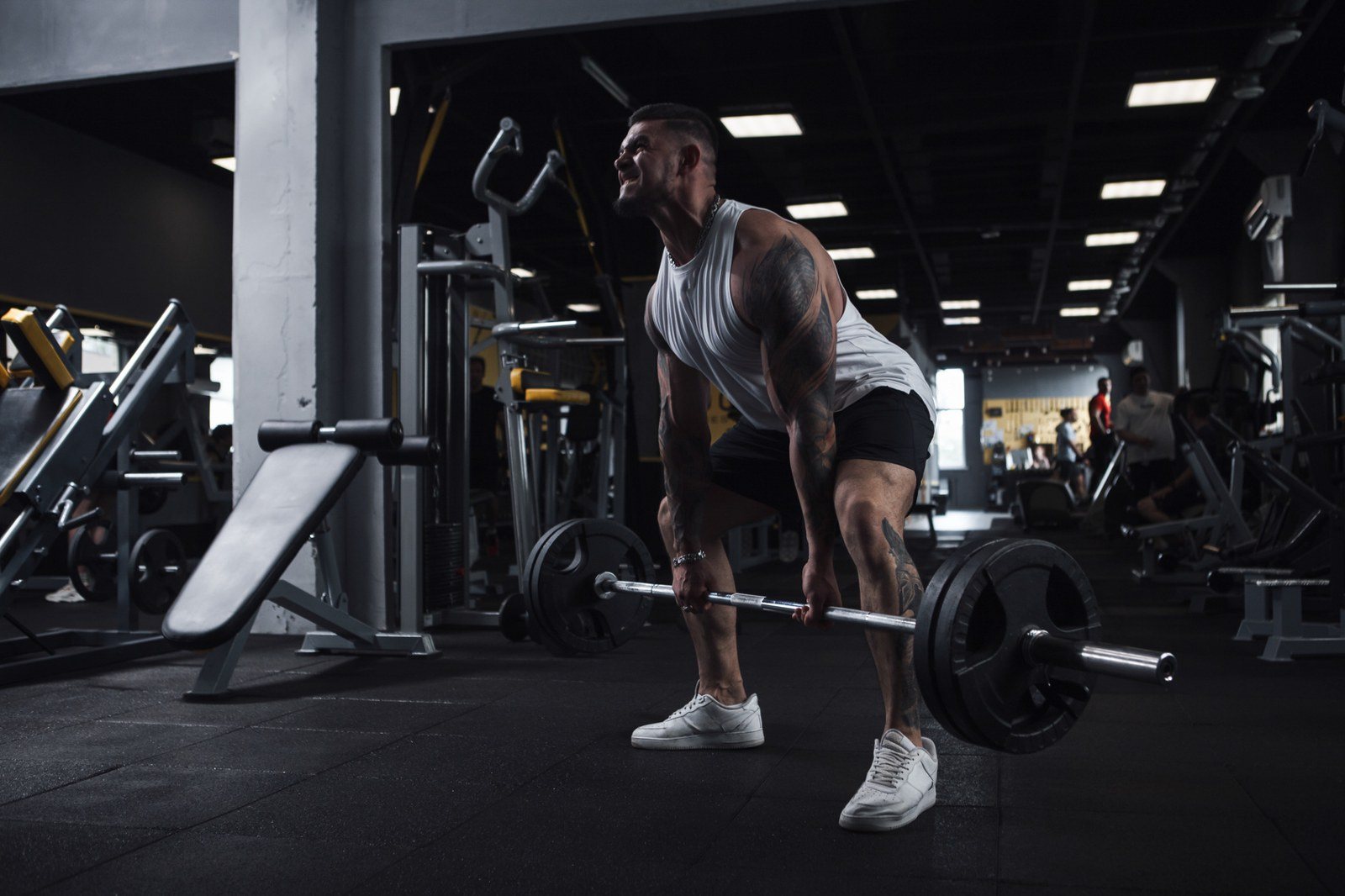
- Use lighter loads when joints are sore, when training at home or when coming back from a break.
- Very high-rep sets are uncomfortable. Many men stop well short of failure, which is where the benefit is lost.
A note on the evidence
Most studies were short and many used untrained participants. Sets were generally taken to or near failure, so the findings do not apply to light sets stopped early. The conclusion is not that load is irrelevant, but that it is one tool among several.
Sources
- Schoenfeld BJ, Grgic J, Ogborn D, Krieger JW. Strength and hypertrophy adaptations between low- vs. high-load resistance training: a systematic review and meta-analysis. Journal of Strength and Conditioning Research, 2017.