Before Captain America, Chris Evans trained chest, arms and abs. His trainer started with his legs
Trainer Simon Waterson found an unbalanced body and rebuilt it with heavy squats, deadlifts and weighted pull-ups. What the research says about heavy and light loads for muscle.
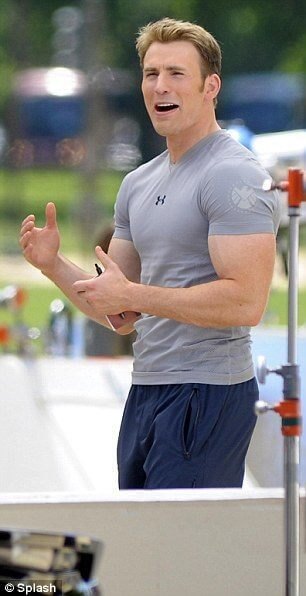
When Chris Evans was cast as Captain America in 2010, the studio wanted a soldier, not a bodybuilder. Trainer Simon Waterson, who had prepared Daniel Craig for Casino Royale, found a problem first. Evans, then 28, had trained what Waterson called the vanity muscles. "He just trained his biceps, and his chest, and his abs, and that was it," Waterson told Insider.
Waterson rebuilt him from the ground up, starting with the legs.
What he did
The programme was built on heavy, low-rep compound lifts: squats, deadlifts, incline bench presses, weighted dips and weighted chin-ups. Waterson added movement circuits and lower-body work to fix the imbalance. The goal, he has said, was performance as well as appearance: a man who could sprint, jump and throw a shield on camera.
Evans had little cardio in the plan. He told Bodybuilding.com that for Captain America it was all about putting on muscle, not losing weight. Waterson has said the hardest part was eating enough to grow without adding fat, using protein shakes and snacks such as fruit and nuts between meals.
What the research says
Heavy loads are not the only way to build muscle, but they are the best way to build strength. A 2017 meta-analysis in the Journal of Strength and Conditioning Research, led by Brad Schoenfeld, compared heavy-load training (above about 60 percent of a one-rep maximum) with light loads. Muscle growth was similar when sets went close to failure. Gains in maximal strength were greater with heavy loads.
That supports Waterson's choice. A character who had to look powerful and move powerfully needed both muscle and strength, and compound lifts deliver both at once. Squats and deadlifts also train the legs and back that a chest-and-arms routine ignores.
Imbalance carries a cost. Waterson has said that at an extreme, an upper-body-only habit can pull posture forward and raise the risk of injury. Training the back and legs as hard as the chest is the simple fix.
How to apply it
- Build each session around one big lift. Squat, deadlift, incline press or weighted pull-up, four sets of five to six reps.
- Balance push and pull. For every set of pressing, do a set of rowing or pull-ups.
- Train legs twice a week. One heavy day (squat or deadlift), one lighter day (lunges, step-ups, 10 to 12 reps).
- Eat enough to grow. A small surplus and about 1.6 g of protein per kg of body weight a day. Snacks between meals help if appetite is the limit.
Evans's change started with the muscles he could not see in the mirror. Most men's training would improve the same way.
Sources
- Insider interview with Simon Waterson, 2022
- Coach magazine interview with Simon Waterson, 2016
- Bodybuilding.com interview with Chris Evans, 2011
- Schoenfeld BJ et al. Strength and hypertrophy adaptations between low- vs. high-load resistance training: a systematic review and meta-analysis. Journal of Strength and Conditioning Research, 2017. doi:10.1519/JSC.0000000000002200