Arnold Schwarzenegger has had four heart operations. He still trains every day at 79
The most famous bodybuilder in history was born with a faulty heart valve that killed his mother and grandmother. What cardiac rehabilitation research shows about exercise after heart surgery.
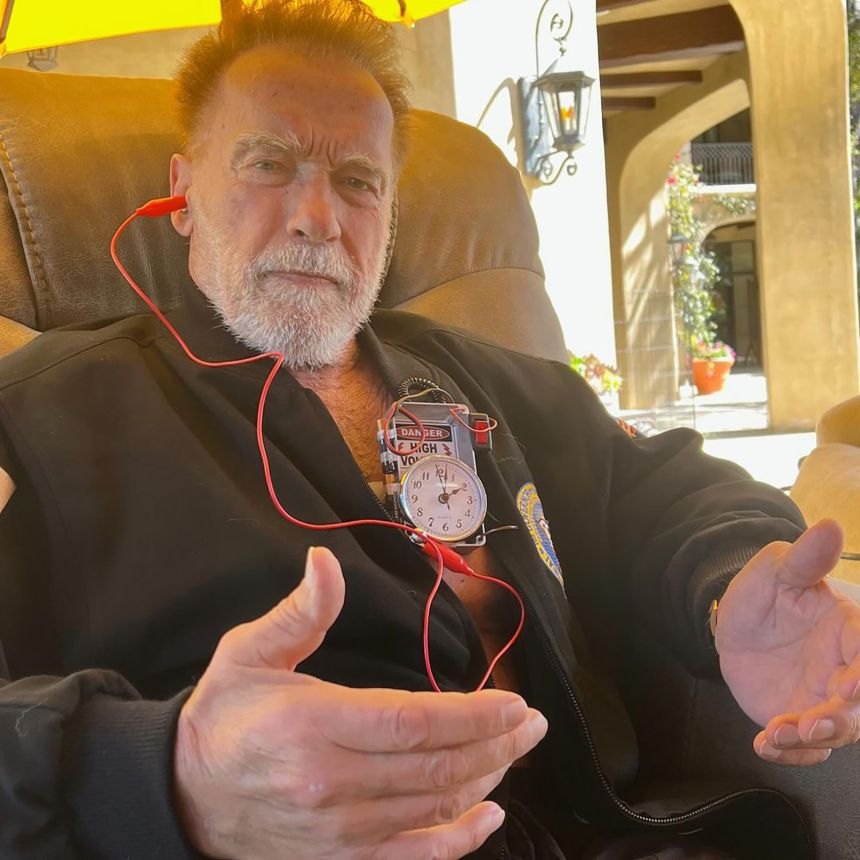
In March 2024, Arnold Schwarzenegger announced on his Arnold's Pump Club podcast that he had been fitted with a pacemaker. "Last Monday, I had surgery to become a little bit more of a machine," he said. By Friday he was at a public event.
It was his fourth heart procedure. Schwarzenegger was born with a bicuspid aortic valve, a congenital defect in which the valve has two leaflets instead of three. Both his mother and his grandmother died of heart disease.
What he did
His heart history, as he and reports have described it, runs as follows. In 1997 he had valve replacement surgery. In 2018 he had open-heart surgery to replace the ageing valve that had been inserted. In 2020 he had a further procedure to replace his aortic valve. In 2024, his doctors recommended a pacemaker because scar tissue from earlier operations had made his heartbeat irregular.
Through all of it, Schwarzenegger has kept training daily, with lighter weights, more cycling and more walking. He said he chose to talk about the pacemaker because people born with the same condition told him his openness had given them courage.
What the research says
A bicuspid aortic valve is the most common congenital heart defect, affecting an estimated 0.5 to 2 percent of people, and it often runs in families. Many people do not know they have it until a doctor hears a murmur or an echocardiogram finds it.
For people living with heart disease, exercise is part of treatment. A 2016 Cochrane-based review in the Journal of the American College of Cardiology, led by Lindsey Anderson, pooled 63 trials of exercise-based cardiac rehabilitation in 14,486 patients. Rehabilitation reduced cardiovascular deaths by 26 percent and hospital admissions by 18 percent, and improved quality of life.
Schwarzenegger's routine reflects that evidence: supervised, regular, moderate exercise, adapted to his heart rather than abandoned because of it.
How to apply it
- Know your family history. If a parent or sibling had a valve problem or early heart disease, ask your doctor about an echocardiogram.
- Report a murmur. If a doctor has ever mentioned a heart murmur, ask whether it has been investigated.
- Do not stop moving after a diagnosis. Ask for a referral to cardiac rehabilitation after any heart event or surgery.
- Train for the long run. Walking, cycling and moderate strength work most days, adjusted with your cardiologist.
Schwarzenegger's heart was never ordinary. His training is proof that exercise belongs in the treatment plan.
Sources
- Arnold's Pump Club podcast, March 2024
- CNN. Arnold Schwarzenegger says he had pacemaker surgery, 29 March 2024
- Siu SC, Silversides CK. Bicuspid aortic valve disease. Journal of the American College of Cardiology, 2010. doi:10.1016/j.jacc.2009.12.068
- Anderson L et al. Exercise-based cardiac rehabilitation for coronary heart disease: Cochrane systematic review and meta-analysis. Journal of the American College of Cardiology, 2016. doi:10.1016/j.jacc.2015.10.044